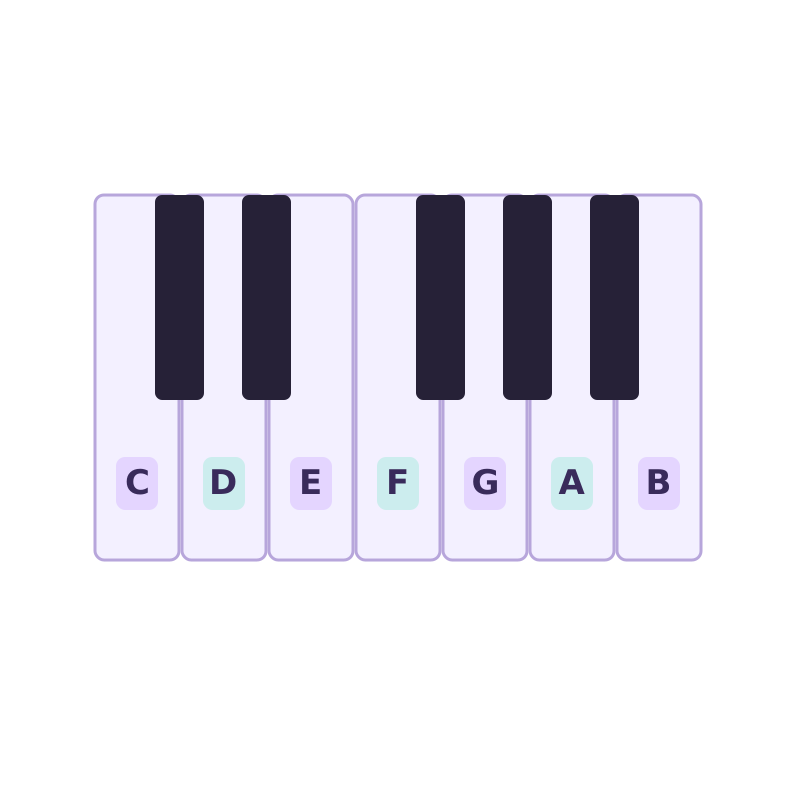
Piano stickers put note names where you can see them while playing. They can be a useful reference when you are learning which key is C or matching a note in your MIDI editor to a physical keyboard. Before buying a set, check key width, key count and the lowest note. “Fits 88 keys” does not mean “fits every keyboard.”
For a beginner who wants a few reference letters, individual adhesive labels offer more control over placement. For a full-size 88-key piano shared with other players, a removable silicone strip is easier to take away between sessions. Neither option is necessary to use SoundToMIDI, and neither changes the accuracy of audio transcription.
As an Amazon Associate I earn from qualifying purchases. This guide compares listed designs and fit requirements; we have not hands-on tested these products. Check the selected variant and current details before ordering.
Two types of piano stickers to consider
| Your situation | Option to check | Main fit question |
|---|---|---|
| You want letters on a few keys, or have a shorter keyboard | COYAHO individual piano stickers on Amazon | Does each label fit within your key’s usable surface? |
| You have a full-size 88-key piano and want labels you can lift off | GICUNK removable silicone labels on Amazon | Does the strip match your key dimensions and spacing? |
The COYAHO listing describes an adhesive set for several keyboard lengths, including 37, 49, 54, 61 and 88 keys. That gives you labels to arrange individually; it does not prove they will fit mini keys. The GICUNK option linked here is intended for a full-size 88-key keyboard. Do not assume an 88-key strip can be cut down for a 61-key instrument.
Measure before you order piano stickers
Count the keys from your instrument’s specifications, then measure a white key and the area where you intend to put the label. Check the product’s dimension diagram, not just the photograph of a piano. On a small MIDI controller, a label can be wider than the key or extend into the space your fingers use.
A silicone strip has a different constraint: its cutouts must line up with the black keys, and the material must sit without catching or restricting any key. The case above the keys can also affect fit. If the seller does not provide enough dimensions to check your instrument, ask about your exact model or choose another design.
Before ordering, write down these four details:
- Instrument model and key count: for example, a particular 61-key keyboard rather than simply “electric piano.”
- Full-size, slim or mini keys: controllers with the same key count can have different key widths.
- Lowest note: use the manual or a reliable note reference; not every keyboard starts on C.
- Label format: letters alone, staff notation, or both. Small notation can be hard to read from your normal sitting position.
Our MIDI keyboard buying guide explains the tradeoffs between compact controllers and larger keybeds. You do not need to replace a working keyboard just to learn its note names.
Adhesive piano stickers or a removable strip?
Individual piano stickers let you start with a few landmarks. You can label only the Cs, or use a small group in the octave you are practicing. They also let you decide how far back to place each letter, subject to the instrument’s care instructions and the label’s size.
The drawback is adhesive contact. A listing’s “removable” claim is not a guarantee for every finish, especially older, damaged or unusual key surfaces. Check your instrument manufacturer’s cleaning and care advice first. Avoid adhesive on a borrowed or valuable instrument unless its owner agrees.
Silicone labels avoid adhesive and can be lifted away for a practice attempt without prompts. They are useful when several people share an instrument. Their drawback is the fixed physical layout: a strip made for standard piano keys may sit badly on a controller with shorter keys or a different case shape. If it moves, catches or changes how a key returns, remove it.
Find C before placing piano stickers
Look for the repeating groups of two black keys and three black keys. C is the white key immediately to the left of a group of two. F is the white key immediately to the left of a group of three. From C, the white keys run C, D, E, F, G, A, B, then repeat.
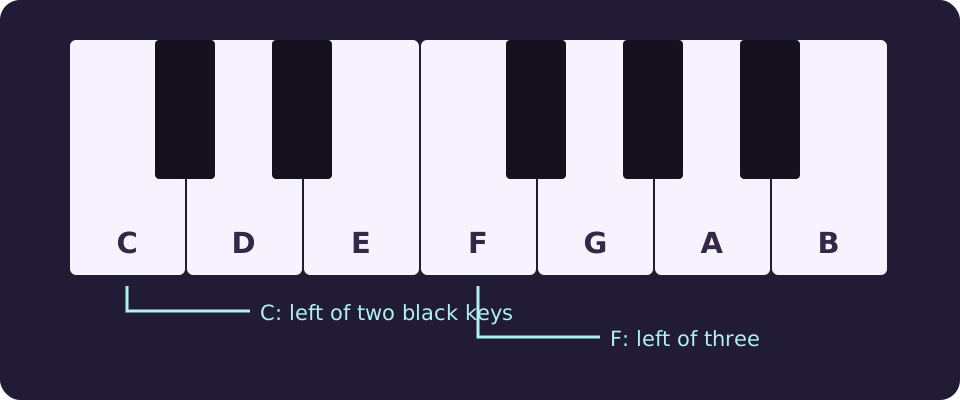
Use this pattern across the keyboard before attaching anything. Do not begin with the far-left key and automatically call it C: an 88-key piano starts on A. On shorter keyboards, confirm the starting note in the manual. Label sheets may include installation maps for several layouts; choose the map that matches yours.
If you are checking converted MIDI, remember that software can use different octave-number conventions. Match the pitch and the repeated key pattern instead of assuming that every program uses the same label for middle C. SoundToMIDI’s piano-to-MIDI tool creates an editable draft from recorded sound; labels are only a reference for playing or checking that draft.
Install and remove labels carefully
With the instrument off, follow its care instructions to clear dust and leave the keys dry. Plan the whole layout before peeling any labels. Keep stickers entirely on the key surface, away from gaps and edges, and check that adjacent keys move freely.
For a removable strip, place it without stretching it to force the cutouts into alignment. Press and release the keys slowly to check clearance. A label system should not interfere with the action or require you to change your hand position.
When removing adhesive piano stickers, follow the label maker’s directions together with your instrument’s care advice. Do not scrape the keys or improvise with solvents. If a label resists or leaves residue, stop and ask the instrument manufacturer which cleaning method is suitable for that surface. We cannot promise residue-free removal across different materials and ages.
Will piano stickers help you learn?
They can show a note name at the moment you need it. Whether that helps your practice depends on how you use the reference. In a beginner discussion on r/musictheory, some players described labels as helpful early on, while others worried about relying on them. Those are personal reports, not a controlled comparison of learning outcomes.
Try a short passage with labels, then cover or remove the reference and find the same notes from the black-key groups. If you can do that comfortably, you may need fewer labels. A teacher can help decide whether letters or staff notation address the particular thing you are learning.
Before buying piano stickers, try the C-and-F landmarks above. If you still want a visible prompt, choose the smallest amount of labeling that solves the problem and check the fit carefully. A readable reference is useful; a crowded keyboard or a poorly fitting strip is not.