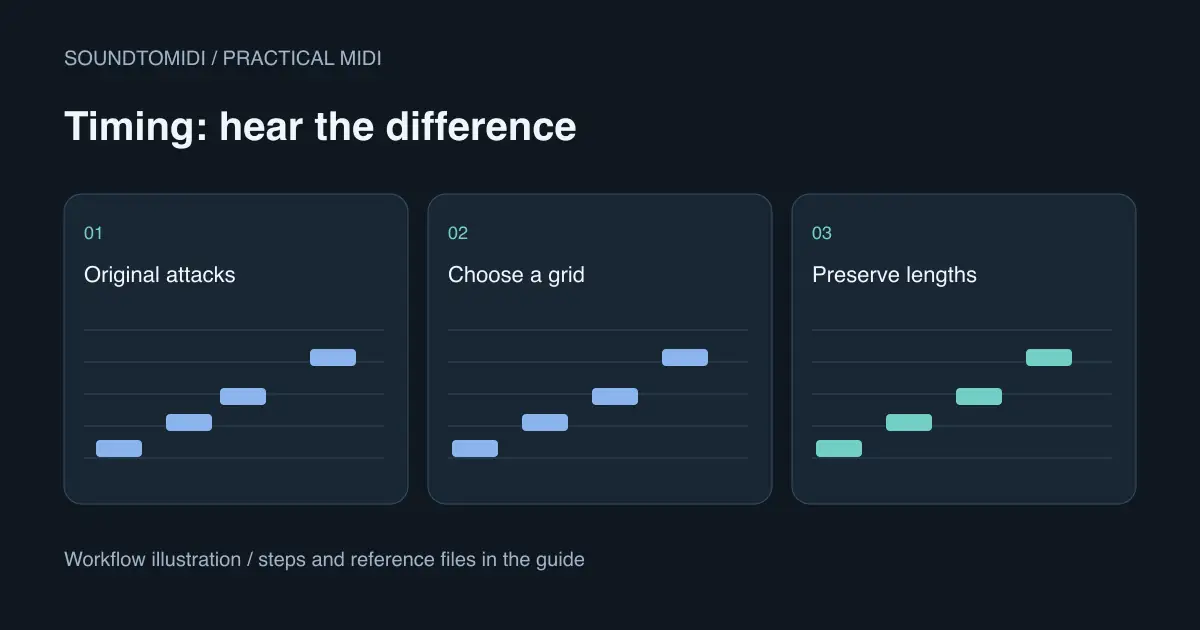
To quantize MIDI, select the notes that need timing correction, choose a rhythmic grid and move their starts toward that grid. Begin with a duplicate of the part and listen after each change. Quantization corrects timing; it does not fix wrong pitches, missing notes or an incorrectly chosen project tempo.
A transcription of a human performance may contain both intentional timing and detection errors. Moving every note to the nearest line can make one phrase tighter and another less musical. The useful question is which attacks should line up, not whether every rectangle looks tidy.
Choose the grid from the rhythm you hear
Count the shortest intended rhythmic value in the phrase. A part using eighth notes usually needs a different starting grid from one containing sixteenth-note fills. Triplets need a triplet grid; forcing them onto straight subdivisions changes the rhythm.
Before applying anything, check the project tempo and the phrase’s alignment. If the first downbeat sits between bars, snapping can move notes toward the wrong beat. If the entire phrase plays at the wrong speed, follow the tempo guide first. Quantization should not become a workaround for a tempo mismatch.
Loop one or two bars and listen with a click. Mark a few attacks that are clearly late or early. Preserve a copy so you can compare the original feel with the edited result at the same tempo and instrument setting.
A small example you can inspect
These two files were constructed for this guide, rather than produced by a transcription model:
Both use 120 BPM, note numbers 60, 62, 64 and 67, and note lengths of 0.35 seconds. Only the start times change:
| Note | Original start | Grid target | Timing correction |
|---|---|---|---|
| 60 | 0.040 s | 0.000 s | 40 ms earlier |
| 62 | 0.540 s | 0.500 s | 40 ms earlier |
| 64 | 0.960 s | 1.000 s | 40 ms later |
| 67 | 1.560 s | 1.500 s | 60 ms earlier |
Import both into separate tracks with the same instrument and solo one at a time. The example deliberately uses quarter notes to make the change easy to inspect. It is not a recommendation to quantize every melody to quarters. At 120 BPM, a quarter note is 0.5 seconds; an eighth is 0.25 seconds and a sixteenth is 0.125 seconds.
Start with note beginnings, then consider strength
For a first pass, adjust note starts while preserving durations. Quantizing the ends as well can shorten a held note or stretch a short articulation. If the rhythm improves but the phrase loses its phrasing, restore the original and reduce the correction strength.
Ableton Live 12’s MIDI manual documents quantization in its MIDI tools, including separate start/end choices and an Amount control. In another editor, look for equivalent settings rather than assuming a shortcut applies everywhere.
As a numerical illustration, a note starting at 0.540 seconds has a 0.500-second grid target. A halfway correction places it at 0.520 seconds. That is useful for understanding strength, but the editor’s exact behavior and grid options should be checked in its own documentation. Listen rather than selecting a percentage because it looks professional.
Clean transcription mistakes before timing edits
An extra 20-millisecond note is not necessarily a quiet grace note. Compare it with the original audio. If it is a false detection, remove it before snapping; otherwise it may become a conspicuous extra attack on the beat.
Repeated notes require another check. A long held sound split into several events needs different treatment from two intentionally repeated notes that were merged. Quantization alone cannot tell those situations apart. Fix the note structure and pitches first, then revisit their timing.
For a fresh recording, the audio-to-MIDI tool provides free local conversion and Raw MIDI download without an account. Use a short isolated part and keep the source for comparison. You can inspect the result before taking it into a DAW for grid-based correction. This guide does not imply that every DAW quantization control exists in the browser editor.
Check the result in the arrangement
Solo listening is useful, but the final test is the phrase against its accompaniment. A bass line may intentionally sit slightly behind the drums. A pickup may belong before the bar line. Preserve those relationships if they are part of the performance you want.
After timing edits, inspect repeated-note boundaries and chord lengths. Moving a start earlier can introduce an overlap with the preceding note even when durations were preserved. The overlapping-note guide explains when that matters and when it is legitimate harmony.
Save the corrected part as a new version. Keep the original until you have checked pitch, timing, articulation and playback in context. A successful quantization pass should make the intended rhythm easier to hear, not merely make the piano roll look regular.